
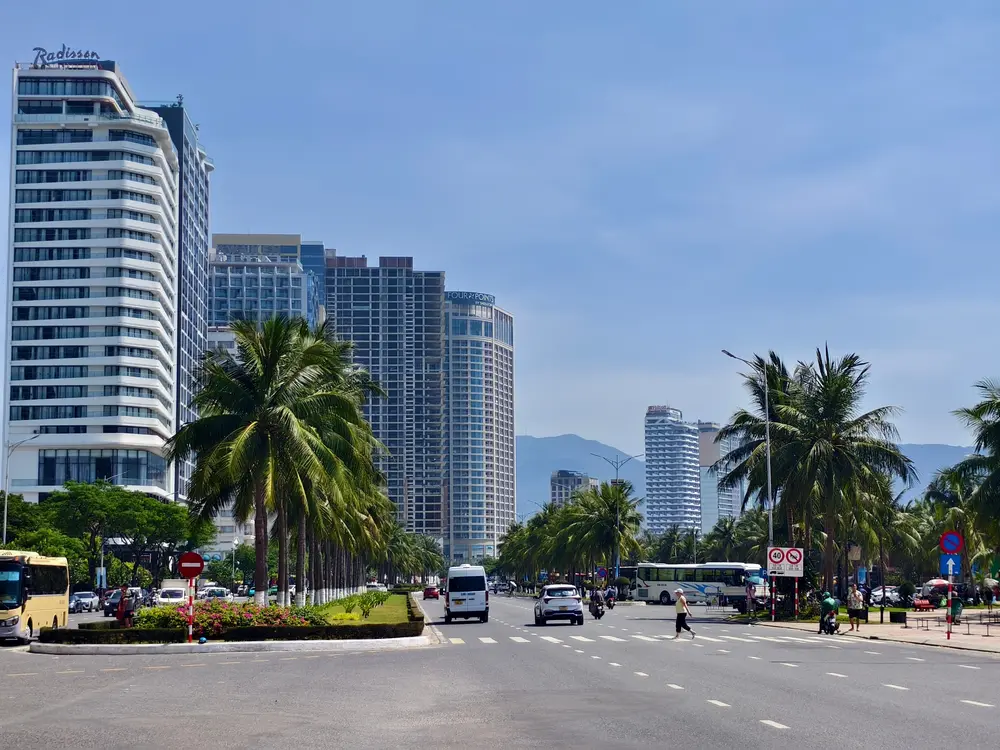

Da Nang is one of Vietnam’s biggest cities, located pretty centrally in the country on the coast. A bustling city with beaches that go on for miles and an international airport, Da Nang is a hub for tourists, digital nomads, and expats. I have been living and working in Da Nang for [insert time], and I’ve loved my time here.
Here’s my personal guide to navigating Da Nang as a digital nomad. This guide to Da Nang features my most important tips and personal experiences living in the city. So stay tuned if you are interested in visiting Da Nang as a digital nomad.
Living in Da Nang – The Basics
Join a Group
This is my main survival tip! Da Nang has a large and active digital nomad scene, and the best way to get involved is by joining groups through WhatsApp or Facebook. There are different groups for all kinds of things. You can find recommendations for events, where to live, where to cowork, link up with people, and more. This is the easiest way to get in touch with other nomads, get great tips from people who have actually lived here, and stay up to date with what’s happening in the community.
Cost of Living and Money
A main draw with Da Nang is its affordability. There are many affordable accommodations, especially out of the usual tourist season, and neither groceries nor eating out are too expensive.
Speaking of money, you do often need to pay in cash here, so be prepared for that. When withdrawing money, you need to be on the lookout for fake ATMs. I’ve been lucky in that department, the only problems I’ve encountered were some ATMs that didn’t accept my card. You should also be aware that ATMs charge a fee of around 3% for withdrawing money.
If you are staying in Da Nang for more than a couple of weeks, I’d even recommend opening up a bank account for the duration of your stay in Vietnam. This can be done very easily in just a couple of minutes and gives you more flexibility in paying, e.g., by using QR codes at restaurants and cafes.
Finding an Accommodation
Here, my main tip is not to rely (solely) on online listings. In my experience, many places are more expensive online, and what is promised in descriptions and pictures is not necessarily what you get. Rooms will often look bigger and nicer in the pictures than in reality.
Instead of prebooking an accommodation for your entire stay, I would recommend booking a hotel only for a week or two after you arrive and then finding your next accommodation when you are actually in the city. Just going down the street, you can easily spot places with vacancies. Either you can speak to the people there directly, or you’ll find a number to call. Renting a place this way is often much cheaper, as there’s no fee for a middleman and you have the possibility to negotiate the prices. Plus, you can see the place and location for yourself beforehand instead of having to rely on polished online listings.
I’d also again recommend utilizing the WhatsApp or Facebook groups for this. Here you can get first-hand accounts and recommendations for good accommodations.
Transportation
My favorite way to get around town is definitely the app Grab, the southeast asian counterpart to Uber. With the app, you can book short trips for little money, without committing to renting your own vehicle.
If you do want the flexibility and freedom of your own vehicle, you can choose between a car and a scooter.
In my opinion, renting a car is only worth it if you have a bigger trip to make, e.g., day trips outside of the city. Otherwise, I find that, like in most big cities, having a car is not necessary or convenient in Da Nang.
A scooter may be the better option here. They are smaller, it’s easier to navigate the busy streets, and of course, they cost less. Renting an electric moped is not too expensive, you can travel around the city independently, and you don’t even have to pay for gas. If your battery is empty, you can just get it exchanged at the dealer.
What you Need to Know about (Co)working in Da Nang
Workspace in Da Nang – Coworking Spaces and Cafés
One thing is for sure here: you’ll easily find a great spot for co-working. In most coffee shops, there’s wifi, and there’ll be many other people working. Really, you can go to any coffee shop, open your laptop, and get to work. But I wouldn’t just settle for any spot. The variety in cafés means that you can be a bit picky, as you are likely to find what you personally like in a café: the right vibe, comfortable seating, tasty food and drink options,…
My two personal favorites are Little Hanoi Egg Coffee and Tabiji Coffee:
Little Hanoi Egg Coffee is a cute little café celebrating Vietnamese cuisine and culture, while Tabijia Coffee is designed to emulate a Japanese style. Both cafés have a great vibe, WiFi, and spots to plug in your laptop, so the most important things you may want in a café for coworking. However, I believe, finding a place that you feel comfortable and productive in mostly boils down to personal preference. Therefore, you should check out different spots to find the one you like best. If you are looking for some places to try out, we have a blog entry for the best cafés in Da Nang, or you can check directly in the app for cafés in your area.
It also comes down to preference whether you want to work in a regular café or a dedicated coworking space. In a regular café, you always run the risk of a higher volume level. If you need a calmer, quieter environment to get some work done, you should probably choose a coworking space. Again, there are plenty to choose from in Da Nang. My personal favorite is Nest Coffee & Coworking Space.
The Digital Nomad Community
This city is a huge favorite amongst digital nomads, so there’s an expansive and active nomad community in Da Nang. There are many online groups and just as many opportunities to meet and connect with people offline, with plenty of groups meeting up regularly and events to attend, like the Da Nang Nomad Fest that just took place at the end of March 2026.
Many coworking spaces and cafés also regularly hold events for networking, and even without those events, you’ll meet like-minded people in these places.
I joined a coworking group with other coders and developers and massively benefited from the experience. The group organizes using a chat with polls to decide in which café the next meeting will take place. At the beginning of the day, everyone is welcome to share what project they are currently tackling. Throughout the day, there are opportunities to share updates of your progress, and at the end of the day, you can present what you’ve built.
If you are facing a problem that you are struggling to solve, or just need a second opinion on something, these chats are a great opportunity. And it’s really rewarding to share your work and the process with other people when you usually work alone, as a lot of us digital nomads do. Inaddition, these meetings help structure your day. It kind of feels like having colleagues and a set work place to go to, except everyone is there voluntarily and excited to work on their own project and you get to try out different cafés.
Where and How to Spend your Free Time
My Personal Guide
I spent most of my time in Da Nang on the peninsula between the Han River and the sea, in An Hai. On this map, I marked the different areas you should be aware of when visiting this area.
- red: the main tourist area, here you’ll find a lot of places catered to foreigners and meet many other tourists and digital nomads.
- pink and black: where the rich live and vacation. Many of us can only dream of living in these expensive hotels, resorts, and luxurious villas, but it may be worth a visit, just to see how the other half lives.
- Turquoise: where the locals go about their daily lives. When visiting, you can probably skip that area.
- Blue: quieter areas with many cafés. This is a good place to go if you want to get away from the hustle and bustle of the city. Especially along the river, this is also a great area to take a relaxing walk.
- Orange: places for working out. The smaller dots are calisthenics stations. As you can see, there are plenty along the beach, but I actually preferred the one at the very top of the map, which is not on the beach. This park was actually a lot less frequented than the others, where you often have to wait in line to use the equipment. Right in the center of the map is a sports center, where you can play many different sports. Beware, this place also gets pretty crowded in the evenings, as many locals come here to work out after their workday.
- Green: 5k lap for running or walking. At the sports center I just mentioned, there’s also a run club, every Monday at 6 PM. The lap follows a nice path along the river. If you are not into running, I’d also recommend this route for a walk!
Nightlife
I’m gonna be honest, this section is going to be rather brief, because I spent most of my time here working and didn’t really go out much. But if you want to experience the nightlife here, you’ll definitely get your fill. Da Nang is a big, touristy city, so there are plenty of opportunities. I’ll keep repeating this till I’m blue, but I’ll say it again: join a WhatsApp or Facebook group! There are groups dedicated just to Da Nang’s nightlife, where you’ll find plenty of input on where to spend your next night out.
I can also recommend using the app LUMA, where you can find out about any events coming up.
What I Liked and Disliked About the City
Let’s wrap this up with my personal likes and dislikes about the city. I’ve previously spent time in different countries and cities through southeast asia, so here’s how Da Nang compares:
What I Liked:
- Big city without feeling like it: with a population of over three million, Da Nang is definitely a big city, which means it offers all the opportunities and benefits of a big city, but at the same time, it has a more laid-back vibe with the beaches and cafés.
- A beach that goes on for literal miles: Need I say more?
- International airport: You can fly directly to the city without needing to figure out a commute via train, car, etc., plus this means there is a diverse, international crowd
- The digital nomad culture: Being a remote worker, traveling around the world can be a bit lonely and overwhelming at times. but not here. There’s a huge, active digital nomad culture here with plenty of groups, shops, and events catering especially to us nomads
- How open and friendly the locals are: Not just in the digital nomad culture, but with the locals, I’ve also noticed how open and friendly everyone here is. People are genuinely interested in having a chat with you and getting to know you.
My Dislikes
And my dislikes, a rather short list, that is mostly overshadowed by the positives:
- The traffic: Crowded streets and sidewalks, the noise of motors, beeping, and exhaust gases – some roads can be a real challenge.
- The language barrier: Not everyone here speaks English, which can lead to some challenges. But because everyone is so friendly and open, this is not even that much of a problem. If needed, the people will resort to some pretty creative sign language to communicate with you.
And that’s pretty much it, the positives definitely outweigh the negatives. I’ve really enjoyed my time here in Da Nang and recommend the city to all other nomads!
Conclusion
Da Nang is a fantastic city for digital nomads. There’s a huge community of us here, plenty of places to co-work, the cost of living is low, and you’ll have a great time living and working here. I certainly did! My main tips wrapped up:
- join groups to get into the digital nomad community
- take part in events to meet people
- try out plenty of cafés and coworking spots
- always carry cash or open a Vietnamese bank account
- don’t prebook your entire stay online
- don’t let the traffic get you down
- enjoy your time!